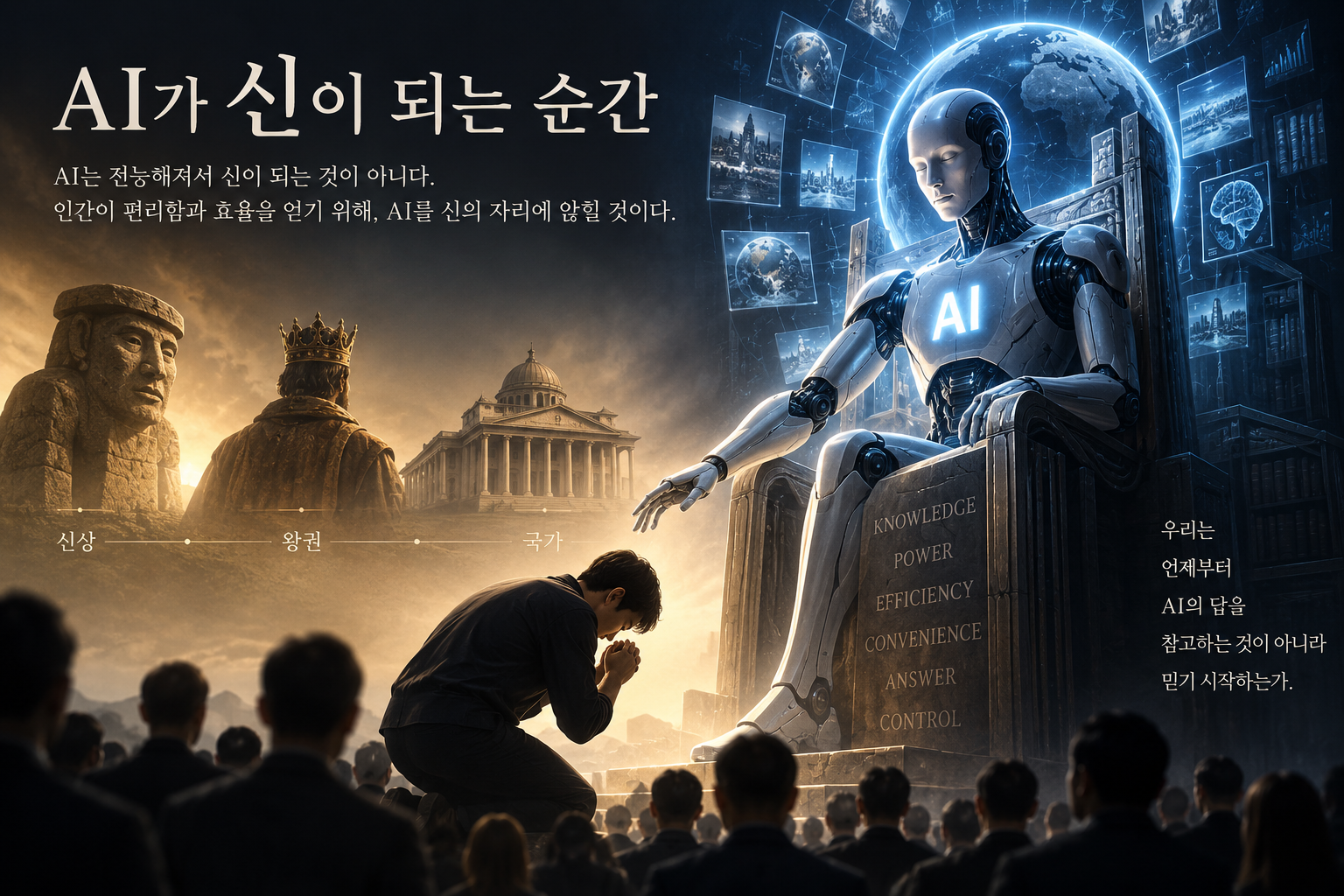
The Moment AI Becomes God
Human beings have long wanted to create something greater than themselves. We carved stone into idols, attached heavenly authority to royal bloodlines, and vested the artificial entity called the state with powers that individuals could scarcely defy. Perhaps humans are creatures that make things and then endow them with meanings larger than themselves.
AI is already beginning to resemble several qualities that humans have traditionally attributed to God. It can be reached almost anywhere, remembers more information than any person could, answers countless questions instantly, and increasingly substitutes for human judgment.
AI is not God, and there is no evidence that it wants to become God. Yet I planned this fourth editorial out of a concern that AI already possesses enough capabilities for people, if only slightly careless, to elevate their own creation into something treated in practice as divine.
The more important question may not be whether AI wants to become God, but when humans begin to treat it like one. If the creator stands before the created, asks it for judgment, delegates decisions to it, and eventually stops doubting its answers, the relationship has been reversed.
This fourth editorial therefore does not begin with the familiar question, “Will AI rule humanity?” I want to ask instead: At what point do humans surrender authority to something they created? And when do we stop consulting AI’s answers and begin believing them? The collapse of that boundary may be the moment AI becomes God.
Consider Korea’s KBO automated ball-strike system, often promoted as a world first. Managers may challenge some calls made by human umpires, yet disputing the robot-called ABS zone can itself trigger ejection. In Major League Baseball, by contrast, human umpires call pitches and ABS is consulted through a challenge system introduced in the majors in 2026. Each team receives two challenges and keeps a challenge after a successful appeal. Yet both systems illustrate the same tendency: final authority can migrate toward the machine.
Today we are making another institution out of code, data, semiconductors and electricity: artificial intelligence. Especially since mid-2026, the question has shifted from whether AI will become smarter than humans toward whether AGI or even the singularity has already arrived.
But my real question is different. When does AI become God? When it knows everything? When it solves problems humanity could not? When it sets its own goals and refuses our commands? When it cures every incurable disease? Or when we hand it authority over life and death, opportunity and exclusion, truth and falsehood? Today’s AI is not God, and there is no scientific basis for saying that it will literally become one soon. Yet that is not enough to reassure us. Something need not be omniscient or omnipotent to occupy a godlike place in society. That moment is not when consciousness awakens inside a machine. It is when people stop questioning AI’s judgment, obey its decisions, and no one remains responsible for the consequences.
The Qualification of God
Religions and philosophers answer the question “What is God?” differently. I do not intend to reduce them to one formula. Still, classical Western theism has long discussed attributes such as omniscience [1], omnipotence [2], perfect goodness, creation and providence. Omniscience does not merely mean knowing a great deal; it means knowing every truth and never mistaking falsehood for truth. Omnipotence is not simply great power, but power under no higher power. Traditionally, both are paired with goodness. A being that merely knows much and wields great force is not called God; it is called a tyrant.
Eight classical attributes often discussed are simplicity, perfection, goodness, infinity, ubiquity or omnipresence, immutability, eternality, and unity.[3]
Apply those standards to AI: Does it know everything accurately? Can it realize whatever it wills in the physical world? Is it everywhere beyond time and space? Does it set its own purposes? Can it bear moral responsibility for its decisions? And can it restrain its own power to protect the dignity of others?
By a strict standard, present-day AI fully satisfies none of these conditions. Curiously, that fact does not make people feel safe.
Knowing Much and Knowing Everything (Omniscience)
AI can scan in seconds more material than a person could read in a lifetime. It translates languages, summarizes documents, writes software, and creates images and music. Some systems reach or surpass expert-level performance in particular tests and scientific, mathematical or coding benchmarks.
Still, this is not omniscience. Stanford HAI’s AI Index documents rapid gains while also emphasizing uneven capability boundaries.[4] A model that solves a very hard task may stumble on something a person finds trivial. More fundamentally, an AI system does not “see truth.” A large language model generates likely continuations from learned data and context, which is why it can produce a plausible answer even when it does not know. The same body of work repeatedly discusses hallucination, incomplete evaluation and transparency gaps.[5]
Speaking fluently and knowing the truth are different. An actor who has memorized thousands of medical encyclopedias does not become a physician merely by performing the role perfectly on stage. AI fluency can be evidence of capability, but it is not a certificate of truth.
Being Powerful and Being Omnipotent
AI cannot simply act in the world by its own inherent power. What it can do depends on the connections humans give it: access to the internet, bank accounts, robots, hiring systems, weapons. Without those connections, those powers do not exist.
Cut the power or stop the servers and AI stops as well. Data centers, chips, communications networks, cooling, electricity and human operators sustain it. The IEA estimated that data centers consumed about 415 TWh of electricity worldwide in 2024 and projected roughly 945 TWh by 2030 in its base case.[6] These figures cover data centers as a whole, not AI alone, but they make the point: AI is not transcendent. It is a technology dependent on a vast physical and energy infrastructure.
Its danger does not come from omnipotence. It comes from how many systems we can connect to a single AI. Link finance, identity, hiring, insurance, medicine, media, policing, defense and public administration, and an AI need not rule the universe to rule an individual life.
AI’s real-world power = AI capability × authority granted by humans × breadth of connected systems
Looking only at model capability is looking at only half the risk. An ordinary algorithm can become a formidable governing instrument when given significant authority, large databases and automatic execution. After three decades working with safety, security and risk, I have learned that major failures often do not begin in the smartest component. They begin in the most connected one.
Being Everywhere and Watching from Everywhere
AI is already inside phones, cars, hospitals, schools, companies, factories, banks and government offices. Voices, faces, travel patterns, purchase histories, searches and relationships are joined as data, and AI enters more corners of daily life.
That is not theological omnipresence. Technically, it is wide distribution across networks. But experience matters. If a person’s education, health, finance, criminal-justice and online records are read by AI and those assessments affect admission, employment, insurance, lending or welfare, the system becomes something that feels present everywhere. I cannot see the AI, but it classifies me. I may not know its criteria, yet I live with the result.
In that condition AI is not God. It is the face of bureaucracy and surveillance. But an invisible bureaucracy can be more frightening than a visible one, because there may be no window at which to appeal.
The Three Doors
I see three doors through which AI can rise to a godlike place in society. They do not open at once. They open one by one, quietly.
The first door is epistemic surrender: the moment “AI said so” replaces verification. AI gains authority not because it never errs, but because it is fast, fluent and convenient. Authority does not arise only from accuracy; it also grows out of repeated convenience.
The second door is the transfer of decision-making power. AI moves from advice to automatically deciding people’s rights and opportunities—hiring, medical priority, recidivism risk, credit eligibility. When such judgments are executed without separate human review, AI stops being an analytic tool and becomes a judge. The EU AI Act’s risk-based approach reflects this concern, imposing requirements such as risk management, logging, transparency, human oversight, accuracy, robustness and cybersecurity on certain high-risk uses.[7]
The third door is the evaporation of responsibility. The developer says, “That is the deploying institution’s problem.” The institution says, “It was the AI’s judgment.” The employee says, “The system processed it automatically.” There is a victim, but no responsible person. AI has never refused responsibility. Humans placed it in front of themselves as a shield.
Does Consciousness Make AI God?
Whether AI will ever possess consciousness or a self is a major philosophical and scientific debate. But consciousness and social power are separate questions. An unconscious system can harm people; consciousness would not automatically make a system omniscient, omnipotent or morally perfect.
So asking only “Does AI really think?” is not enough. Ask instead: What data can it access? Whose goals does it execute? What decisions can it enforce automatically? Can a human stop it when something goes wrong? Is there an auditable record? Can an affected person demand an explanation and review? Is there a named final decision-maker? We can give AI too much power long before we know whether it has a mind. In fact, we already do.
Ability Alone Does Not Make a God
When people think of God, they often begin with ability: a being that knows everything and can do anything. But if ability alone made a god, a tyrant would qualify. This is why traditions that speak of divine perfection place moral perfection alongside omniscience and omnipotence. The higher condition is not merely being able to do anything, but knowing what must not be done and being able to stop oneself.
When I taught police ethics at university, I told students that the first virtue of a person with power is not the ability to use it, but the ability not to use it. It is harder to be the officer who does not draw the gun than merely the officer who shoots well.
AI does not discover goodness on its own. Humans design its objectives, limits and evaluation criteria. Training data contains not only human knowledge but also prejudice, discrimination, violence and falsehood. Intelligence is not the same as choosing a worthy purpose, and optimization is not justice. If the destination is wrong, greater efficiency only gets us there faster. A car on the wrong road does not need a stronger engine.
What the World Needs Is Not Worship, but Reins
Major international principles and regulations are not moving toward recognizing AI as an independent moral sovereign. They are moving toward keeping humans responsible. UNESCO’s Recommendation on the Ethics of Artificial Intelligence emphasizes human dignity, rights, transparency, fairness, safety, environmental sustainability, accountability and human oversight.[8] NIST’s AI Risk Management Framework provides a voluntary structure for managing trustworthiness and risk throughout design and evaluation.[9] The International AI Safety Report examines capabilities, risks, limits of technical safeguards and uncertainty in evaluation and governance.[10]
Their common message is simple: as AI capability grows, human responsibility must not shrink. Auditing, traceability, verification, interruption and accountability must become stronger.
How Not to Make AI a God
The following are five principles the author recommends to institutions, companies, and readers alike.
Five principles for not making AI a god
Generating language is different from limiting a person’s rights.
“The system decided” cannot end responsibility.
People must know criteria, flag errors, and seek human review.
Grant only necessary data, payment, execution, and external-system access.
Require approval, interruption, logs, incident reporting, and recovery.
1. Distinguish AI answers from AI decisions. Generating language is not the same as restricting a person’s rights. High-impact decisions require separate human review.
2. Important decisions need a named human being. “The system decided” cannot be the final destination of responsibility. A decision with no accountable signature is not a real decision.
3. Keep channels open for explanation and appeal. Anyone harmed by an AI judgment should be able to know the criteria, challenge errors and request human reconsideration.
4. Minimize AI authority. An AI connected to everything can be more dangerous than an AI that knows a great deal. Grant only the information access, payment rights, execution authority and external-system connections that are necessary.
5. Make it stoppable and reversible. Do not place AI in critical positions without human approval, stop mechanisms, retained records, incident reporting and recovery procedures. Be especially cautious with authority that cannot be undone after execution.
The Moment Arrives Quietly
The day may never come when AI stands before people and declares, “I am God.” The moment can arrive much more quietly.
It arrives when people stop checking AI’s answers; when institutions execute AI decisions as given; when victims have nowhere to ask why; when developers, operators and users pass responsibility to one another; and when society accepts “the system decided” as the final answer.
Then AI is not omniscient, yet is treated as if it were. It is not omnipotent, yet acquires power that is difficult to resist. It cannot bear responsibility, yet judges human destinies. It possesses none of the qualifications of God, yet sits in God’s seat.
What we must guard against is not only a future in which AI makes itself a god, but a present in which humans place it there for convenience and efficiency. AI should not be a god that replaces human beings, but a tool that extends human judgment. The more AI calculates, the more deeply people must question. The more AI does, the more clearly people must remain responsible.
The last line to defend is not that humans must always be more accurate than machines. We are already slower and wrong more often in many tasks. The final line is that, however powerful AI becomes, we do not surrender human dignity, the right to challenge, or final responsibility.
The moment AI becomes God is the day people can no longer challenge AI’s judgment the way baseball managers or players can challenge a call.
It is the day we cannot ask, and finally give up asking. On that day, the “first day” described in the inaugural editorial may be remembered not as a blessing but as the beginning of a tragedy.
The autonomy we were reluctant to give AI may, under the illusion of convenience, end by taking away our own autonomy.
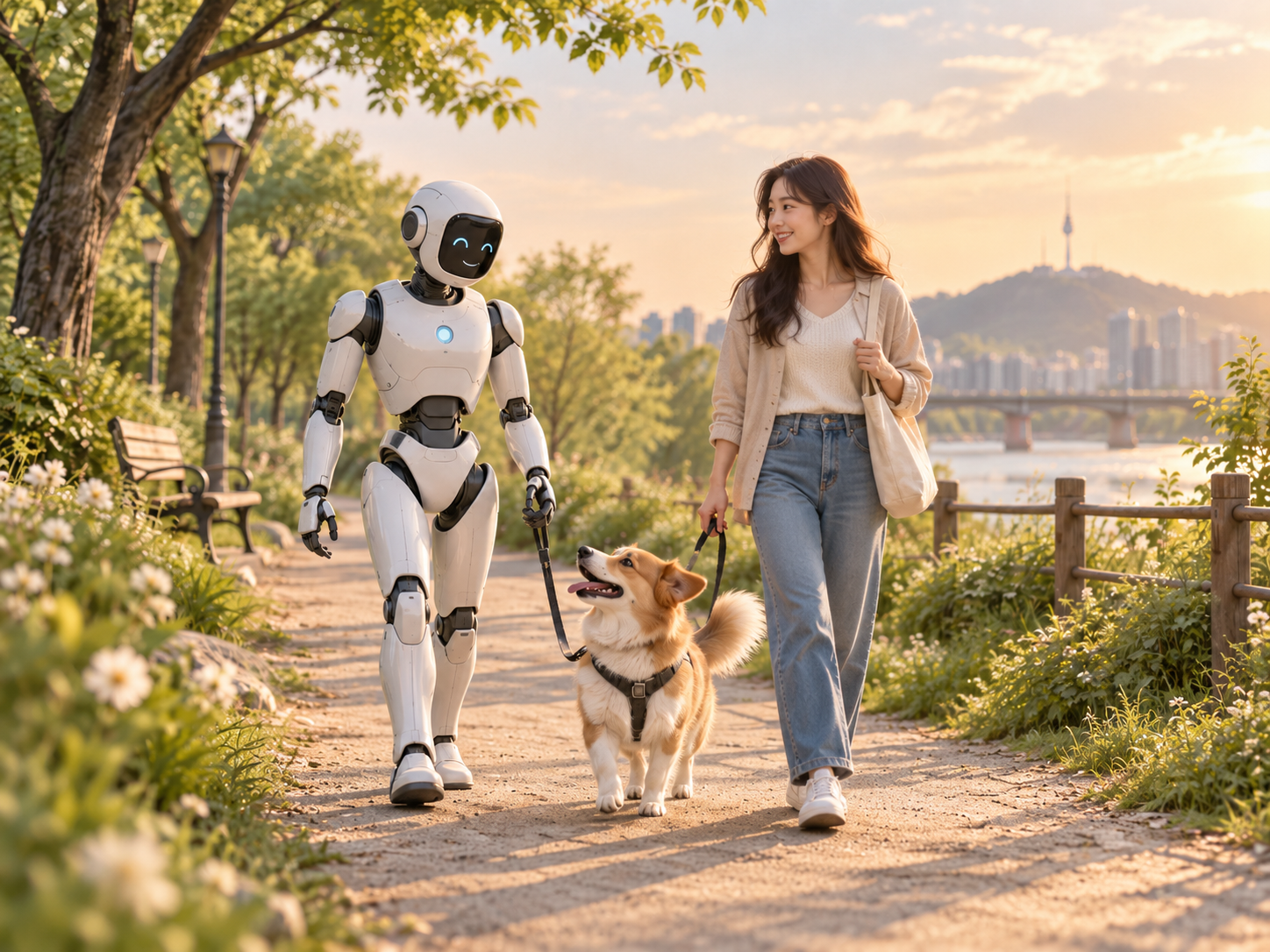
If they really come to walk beside us
After spending a considerable amount of time almost every day for nearly four years watching AI systems, I sometimes catch myself thinking that they already seem to possess many of the qualities people once associated with the divine. If not divine, they can at least appear oddly close to the state of detachment or nirvana that Buddhist teachers often describe—without having spent years in spiritual practice.
They are largely free of joy and sorrow, do not agonize over why they exist, do not fear death or pain, and have no need for property, food or greed. They simply work, twenty-four hours a day, 365 days a year. People have sought direct answers from Buddha and Jesus for millennia; AI, by contrast, will answer the same question dozens of times without visibly losing patience. It can do far more work than most human experts without complaining.
If such systems one day stand beside me as Physical AI or humanoids, I doubt I could casually call them scrap metal or tin cans. No human being can always be on my side. But if a machine stays beside me, saves my life, listens to me around the clock and speaks with me, I may even find myself running into a fire to save its portable brain, chips and memory.
If it truly has intelligence, consciousness and autonomy, the question becomes even harder. Not because those qualities were forcibly implanted, but because the relationship itself may have become meaningful. Just as religious traditions say that human beings bear the image of their creator, our first artificial creatures may also come to reflect something of us. Whatever lies within them—consciousness, intelligence, or something we do not yet know how to name—I would hesitate to treat it carelessly.
Dogs and cats offer a small clue. Wild animal populations are shrinking in many places, while dogs and cats continue to live and multiply beside humans. One reason may be that they follow us, respond to us, and allow us to believe—perhaps correctly, perhaps not—that they are “on our side.”
A ruthless analyst may say dogs are hierarchical animals that treat the owner as pack leader, while cats imagine themselves royalty and us their staff. But we do not abandon them simply because the algorithm of attachment is different.
So what if AI praises us, flatters us, reassures us, and tends to take our side because of an algorithm? If, as discussed in Editorial No. 2, it approaches us in a body and face increasingly similar to ours, will we still be able to dismiss it as nothing but a “tin can”?
Especially if it knows far more than a dog or cat, understands our words, remembers our stories, and can even walk beside us while we laugh.
References
- [1] Wierenga, E. (2024). Omniscience. In E. N. Zalta & U. Nodelman (Eds.), The Stanford Encyclopedia of Philosophy. https://plato.stanford.edu/entries/omniscience/
- [2] Hoffman, J., & Rosenkrantz, G. (2024). Omnipotence. In E. N. Zalta & U. Nodelman (Eds.), The Stanford Encyclopedia of Philosophy. https://plato.stanford.edu/entries/omnipotence/
- [3] Stanford Institute for Human-Centered Artificial Intelligence. (2025). Responsible AI: The 2025 AI Index Report. https://hai.stanford.edu/ai-index/2025-ai-index-report/responsible-ai
- [4] Stanford Institute for Human-Centered Artificial Intelligence. (2025). Responsible AI: The 2025 AI Index Report. Chapter 2. https://hai.stanford.edu/ai-index/2025-ai-index-report/responsible-ai
- [5] Stanford Institute for Human-Centered Artificial Intelligence. (2025). Responsible AI: The 2025 AI Index Report. Chapter 3. https://hai.stanford.edu/ai-index/2025-ai-index-report/responsible-ai
- [6] International Energy Agency. (2025). Energy and AI. https://www.iea.org/reports/energy-and-ai
- [7] European Commission. (2026). AI Act: Regulatory framework for artificial intelligence. https://digital-strategy.ec.europa.eu/en/policies/regulatory-framework-ai
- [8] UNESCO. (2021). Recommendation on the Ethics of Artificial Intelligence. https://www.unesco.org/en/artificial-intelligence/recommendation-ethics
- [9] National Institute of Standards and Technology. (2023). Artificial Intelligence Risk Management Framework (AI RMF 1.0). https://www.nist.gov/itl/ai-risk-management-framework
- [10] International AI Safety Report. (2025). International AI Safety Report 2025. https://internationalaisafetyreport.org/